Queer Places:
Harrow School, 5 High St, Harrow HA1 3HP, United Kingdom
University of Cambridge, 4 Mill Ln, Cambridge CB2 1RZ
All Saints Churchyard, Church Ln, Aylesbury HP22 4HL, United Kingdom
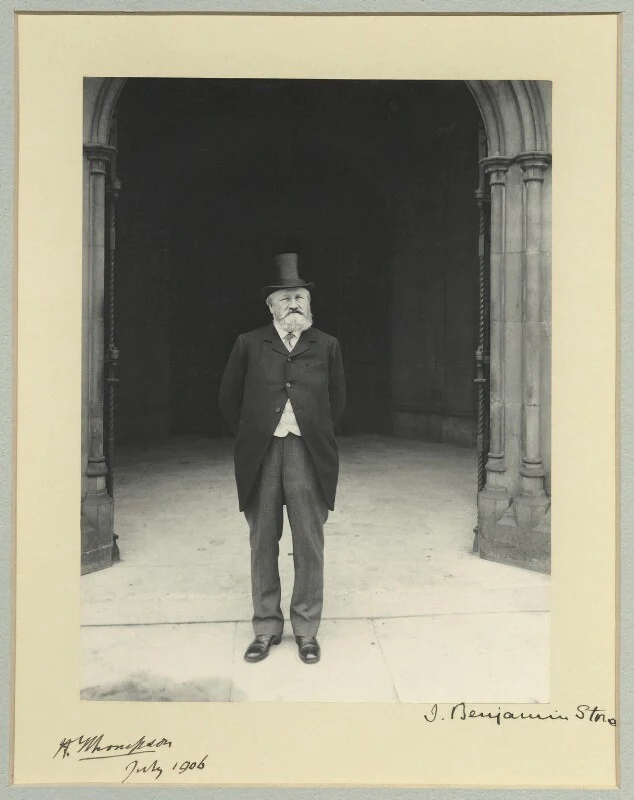 Henry Yates Thompson (December 15, 1838 – July 8, 1928) was born on December 15, 1838, in Liverpool, the eldest of five sons born to Samuel Henry Thompson, a wealthy banker,
and Elizabeth Yates. Coming from a prominent Lancashire family with deep mercantile and intellectual roots—his maternal grandfather was the West India merchant and antiquary
Joseph Brooks Yates—he was destined for an elite Victorian education. He attended Harrow School, where he distinguished himself early, before entering Trinity College,
Cambridge. At Cambridge, his academic brilliance shone through classic literature; he won the prestigious Porson Prize for Greek verse in 1860, claimed the Browne Medal
twice (in 1860 and 1861), earned a scholarship in 1861, and graduated in 1862 as 16th Classic in the First Class of the Classical Tripos. During his university years, his
intellectual circle expanded significantly when he was inducted into the elite, secretive discussion society known as the
Cambridge Apostles.
Henry Yates Thompson (December 15, 1838 – July 8, 1928) was born on December 15, 1838, in Liverpool, the eldest of five sons born to Samuel Henry Thompson, a wealthy banker,
and Elizabeth Yates. Coming from a prominent Lancashire family with deep mercantile and intellectual roots—his maternal grandfather was the West India merchant and antiquary
Joseph Brooks Yates—he was destined for an elite Victorian education. He attended Harrow School, where he distinguished himself early, before entering Trinity College,
Cambridge. At Cambridge, his academic brilliance shone through classic literature; he won the prestigious Porson Prize for Greek verse in 1860, claimed the Browne Medal
twice (in 1860 and 1861), earned a scholarship in 1861, and graduated in 1862 as 16th Classic in the First Class of the Classical Tripos. During his university years, his
intellectual circle expanded significantly when he was inducted into the elite, secretive discussion society known as the
Cambridge Apostles.
Following his graduation, Yates Thompson was admitted to Lincoln's Inn and called to the Bar in 1867. Though legally trained, he never actively practiced law. Instead,
his early adulthood was defined by extensive travels across Europe and the United States—an eventful journey during which he personally witnessed the Second Battle of
Chattanooga—and public service. From 1868 to 1874, he served as private secretary to Earl Spencer, the Lord Lieutenant of Ireland, and he made multiple unsuccessful attempts
to enter the House of Commons as a Liberal candidate for South Lancashire in the general elections of 1865, 1868, and an 1881 by-election. He also held civic
responsibilities as a Justice of the Peace and Deputy Lieutenant for the County Palatine of Lancashire.
In 1878, Yates Thompson married Elizabeth Smith, the eldest daughter of George Smith, the founder of the Dictionary of National Biography. This union further enmeshed him
in Britain's literary and publishing elite. Two years into the marriage, his father-in-law gifted him ownership of the Pall Mall Gazette. Although the publication had
previously maintained a Conservative stance, Yates Thompson boldly transformed it into a leading Liberal organ. He appointed John Morley as editor, followed by
W.T. Stead, whom Thompson famously supported through the fierce moral and legal controversies surrounding Stead's 1885 child
exposé, "The Maiden Tribute of Modern Babylon." Despite overseeing the newspaper during one of its most dynamic and influential historical eras, Yates Thompson possessed
little personal affinity for the day-to-day pressures of the publishing business, ultimately selling the Pall Mall Gazette to William Waldorf Astor for 50,000 pounds in
1892.
The divestment of the newspaper freed Yates Thompson to devote himself entirely to his true passion: the collection and study of illuminated medieval manuscripts. His
foundational interest had been sparked decades earlier in 1855 when he inherited ten medieval manuscripts from his grandfather. By the 1890s, he leveraged his considerable
wealth to become Britain's premier manuscript collector, aggressively acquiring treasures dispersed from legendary libraries such as those of Sir Thomas Phillipps, Firmin
Didot, John Ruskin, and the Earl of Ashburnham. Gifted with a prodigious memory, he frequently reunited long-separated manuscript volumes. Driven by a desire to maintain an
impeccably curated cabinet rather than a sprawling archive, he instituted a strict self-governing rule: his collection would be strictly capped at 100 masterpieces. Whenever
he acquired a superior specimen, he would sell or donate a lesser one to make room, ensuring the collection's overall quality remained peerless. His magnificent library was
catalogued across four volumes between 1898 and 1812 by scholars including M.R. James. Recognizing his deep bibliographic expertise, Cambridge University twice appointed him
as the annual Sandars Reader in Bibliography in 1901 and 1904, where he lectured on English and French illuminated manuscripts.
Yates Thompson was also a generous philanthropist, directing his wealth toward educational and civic institutions. He funded an art school at Harrow, provided a library
for Newnham College, Cambridge (in conjunction with his wife), built public palm houses in Sefton and Stanley parks, and donated hospitals to Crewe and the Horwich railway
works, achievements that earned him the Freedom of Liverpool in 1901. In later life, he began systematically distributing his manuscript treasures to major public
institutions, including the British Museum, the British Library, the Bibliothèque Nationale de France, and the Fitzwilliam Museum. He died on July 8, 1928, at his London
home at the age of 89, and was buried at All Saints Churchyard in Oving, Buckinghamshire. Following the subsequent death of his wife Elizabeth in 1941, the remainder of his
collection passed to the British Museum, cementing the Yates Thompson manuscripts as one of the institution's premier closed collections.
Regarding potential LGBTQ+ historical links, Henry Yates Thompson operated within elite 19th-century British social and intellectual networks that frequently intersected
with same-sex romantic and homosocial dynamics. Most notably, his membership in the Cambridge Apostles—a select intellectual society whose members historically formed
profound, lifelong, and occasionally homoerotic emotional bonds (such as those seen among later generations like Lytton Strachey and John Maynard Keynes)—places him squarely
within a milieu where non-traditional intimate and homosocial relationships were both common and tolerated. However, his life outwardly conformed to Victorian societal
expectations through his long marriage to Elizabeth Smith and his conventional public career. While biographers and social historians frequently examine the homosocial
intimacy of the Apostles and the homosocial travel and political circles of Victorian gentlemen, no explicit documentation, diaries, or surviving correspondence definitively
confirm personal queer relationships or self-identification for Yates Thompson himself.
References:
Other references:
- https://en.wikipedia.org/wiki/Henry_Yates_Thompson
- https://findingaids.lib.umich.edu/catalog/umich-wcl-M-3465tho
- https://newn.cam.ac.uk/yates-thompsons
- https://www.dulwichsociety.com/people/henry-thompson
Support this project
This website is a passion project researched, developed, and funded entirely by me. If you find the content valuable and would like to help support the ongoing research and hosting costs, any contribution is deeply appreciated.
Thank you for keeping this independent resource alive!
My books on Amazon: Elisa Rolle's books
BACK TO HOME PAGE
